The Action-Based Research (ABR) initiative was designed by InterAction’s protection team to address the persistent gap between the humanitarian sector’s commitment to the Centrality of Protection (CoP), as enshrined in the IASC CoP policy, and the ongoing challenge of shifting humanitarian actors towards an outcome-oriented approach to reducing protection risks. To bridge this gap, the ABR was developed as a set of pilot projects using Results-Based Protection (RBP) to demonstrate for the sector practical, effective approaches to implementing CoP.
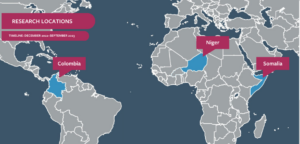
Between 2023 and 2025, InterAction worked with international, national, and local partners in Colombia, Somalia, and Niger to demonstrate how humanitarian actors can move from collective commitments to the Centrality of Protection toward practical, measurable strategies to reduce protection risks by using Results-Based Protection. The initiative focused on the reinforcing relationship between armed conflict, food insecurity, and protection risks.
Key Takeaways
- The ABR showed that results-based protection is feasible and valued. With adequate time, training, and community input, humanitarian actors can develop multidisciplinary strategies with the potential to reduce protection risks.
- Results-Based Protection simultaneously strengthens multiple sectors. A protection lens helped food security actors identify risks undermining their work, while food security provided an entry point where explicit protection approaches were sensitive or contested.
- Broader uptake of results-based protection remains constrained by humanitarian funding cycles, coordination processes, organizational culture, and approaches to risk.
- Future cross-organizational pilots should resource in-country co-leadership, link community engagement to tangible action, and secure leadership and donor commitment from the outset.
- To further strengthen scalable approaches to the Centrality of Protection, donors must fund pilots that test them under real-world conditions.
- PROJECT GOALS AND ACHIEVEMENTS:
Through a multi-disciplinary, multi-organizational effort, the aim of the project was to create contextualized, community-baseed analysis of key protection risks in each country context and develop and implement context-specific theories of change, to model pathways for the uptake of outcome-oriented ways of working to address protection issues manifesting due to conflict-induced food insecurity.
Although the project concept notes went unfunded in the wake of 2025 global cutbacks to humanitarian funding, the research generated actionable research for practicioners of outcome-oriented protection.
USE THE LEARNING FROM THE ABR PROJECT Expand All
How validation changed strategies, the trade-offs between in-territory and off-site engagement, and the use of community-led processes.
Case ExampleHow shared analysis and decision-making can strengthen locally led protection strategies.
Case ExampleHow terminology, translation, silence, and indirect communication shape risk analysis and safe engagement.
Case ExampleHow a risk-based approach connects CRSV, food insecurity, clan dynamics into multidisciplinary collective strategies.
Case ExampleWhat legal, political, and organizational constraints and risk tolerance mean for holistic, threat-focused protection strategies.
Case ExampleThis webinar explored how humanitarian actors can meaningfully engage communities in shaping strategies to reduce protection risks using community validation – a practice tested through InterAction’s Action-Based Research and grounded in the Results-Based Protection (RBP) framework – as an entry point,
WebinarThis webinar examined the evolving role of multi-disciplinary strategies in humanitarian response, with a particular focus on how such strategies can be operationalized to achieve protection outcomes amid growing constraints on resources and access.
WebinarThis brief sheds light on a troubling cycle where armed conflict exacerbates food insecurity and protection risks, perpetuating a cycle of vulnerability. Despite the pervasive nature of this cycle, the study highlights diverse experiences within and between communities. It emphasizes the need for nuanced, context-specific solutions by humanitarian actors in the regions and presents a learning opportunity for the global humanitarian community.
Advocacy Brief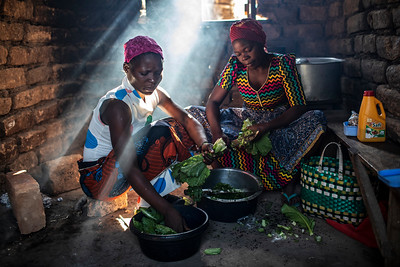
WHY FOCUS ON THE LINK BETWEEN CONFLICT-INDUCED HUNGER AND PROTECTION?
Armed conflict is the single biggest challenge to achieving zero hunger. According to the U.N. World Food Programme, almost 60% of the 690 million people facing acute hunger around the world live in areas affected by armed violence. The lack of respect for civilian life and property by parties to conflict disrupts food systems and food markets, destroys livelihoods and employment, and threatens development gains.
Conflict-induced hunger increases protection risks and displaces people. State and non-state parties to conflict cause hunger and starvation through violence, coercion, and deliberate deprivation. Acts such as restricting people’s movements, failing to act when food is blocked, or selectively providing food aid also contribute to hunger and starvation. Additionally, food insecurity contributes to risks such as family separation, gender-based violence (sexual abuse and exploitation), and physical attacks as people search for food, water, and access to services.
Photo to Left By: Will Baxter is licensed under the CC BY-NC 4.0 license.
WHERE WE WORKED Expand All
Partners explored how territorial control by armed actors restricted movement, livelihoods, food access, and community autonomy. Country groups developed strategies addressing confinement in Quibdó and economic coercion in Tibú, then returned draft theories of change to communities for validation. In Quibdó, community organizations used flexible microgrants to bring validation to more than 25 communities and connect the original strategies with tangible self-protection, governance, and livelihood actions.
Community analysis examined punishments imposed on people pursuing movement-based livelihoods in areas under Al-Shabaab control, cycles of clan-based revenge killing and conflict-related sexual violence, and inter-clan violence linked to resources and displacement. Partners developed multidisciplinary strategies combining mediation, religious and elder dialogue, livelihoods, early warning, local justice, and other forms of community protection.
Community research examined how displacement, livelihood collapse, hunger, recruitment, and gendered exploitation reinforced one another. The project location was discontinued in mid-2024 following the initial analysis stage due to political instability, access constraints, and country-group turnover.
Recommendations for future efforts to implement outcome-oriented protection
For organizations implementing outcome-oriented protection:
- Commit to participatory analysis and validation. Focused community conversations can reveal risks and entry points missed by standard assessments, while validation strengthens accountability, tests assumptions, and grounds strategies in community priorities.
- Develop focused, risk-based theories of change. Organizing work around a clearly defined protection risk provides a shared foundation for multidisciplinary strategy, measurement, learning, and adaptation.
- Integrate across teams, sectors, and disciplines. Reducing protection risks requires deliberate collaboration among humanitarian, development, peacebuilding, government, and community actors.
- Confront the challenge of threat reduction. Organizations must clarify how they can responsibly influence perpetrators, when specialized actors should lead, and how to avoid transferring risk to local partners.
For donors supporting outcome-oriented protection:
- Recognize funding structures as a major barrier. Short timelines, rigid frameworks, and pressure for rapid delivery constrain participatory analysis, adaptation, learning, and longer-term risk reduction.
- Align funding with protection outcomes. Require projects to define and measure reductions in specific risks while funding longer timelines, flexibility, local leadership, consortia, multidisciplinary approaches, and outcome-oriented evaluation.
TIMELINE FOR THE ACTION-BASED RESEARCH
January – March 2022
Research framework & methodology developed
September 2023
Partnership and Country Groups formed
September 2023 – March 2024
In-country participatory protection analysis
May 2024 – February 2025
Context-specific theory of change, validation and action planning
January-June 2026
Rollout of Summary Report for Somalia and Global Report



Funding for this project is provided by the Swedish International Development Cooperation Agency (SIDA). The ideas, opinions, and comments here are entirely the responsibility of InterAction and do not necessarily reflect SIDA’s policy.